If you're trying to decide between McKinney and Frisco, you're actually choosing between two of the strongest real estate markets in the country.
WalletHub released its 2026 Best Real Estate Markets study on August 19, ranking Frisco #1 and McKinney #2 in the United States.
WalletHub compared 300 cities using 17 different measures of real-estate market strength and economic environment — looking at factors including affordability, housing inventory, home-value growth potential, new construction and the strength of the local job market.
You can see WalletHub's complete 2026 rankings and methodology here.
But here's what a national ranking can't tell you:
What is it actually like to live in McKinney versus Frisco?
These neighboring cities may sit at #1 and #2 on the same national list, but they didn't get here the same way — and they don't feel the same once you live here.
That difference affects everything from neighborhoods and schools to shopping, entertainment, parks and what you see when you drive home every day.
McKinney feels like an established Texas city that grew outward. Frisco feels like a modern city that was largely built during its growth boom.
McKinney has a historic downtown, older neighborhoods alongside master-planned communities, mature trees, extensive parks and trails, and a city identity intentionally tied to its history and natural spaces.
Frisco's identity is much more connected to rapid growth, major retail, sports and entertainment destinations, corporate development and newer master-planned neighborhoods.
Both are now large cities. McKinney's January 2026 population estimate is approximately 237,130, while Frisco currently estimates approximately 248,971 residents.
But similar population numbers don't make these cities feel the same.
McKinney Had a 50-Year Head Start
This is probably the biggest difference people miss.
McKinney became the Collin County seat in 1848 and was incorporated in 1849. Its location was chosen partly because Texas required the county seat to be near the geographic center of Collin County.
That history is still physically visible.
Historic Downtown McKinney isn't a modern shopping development designed to look like an old town. It's the city's original center, built around the courthouse square. The surrounding historic neighborhoods, older commercial buildings and street pattern grew from there.
Frisco has history too, but today's city developed on a very different timeline.
The community that became Frisco grew around the St. Louis-San Francisco Railway in the early 1900s. The name Frisco was adopted in 1904, and the city incorporated in 1908.
As recently as 1990, Frisco had only about 6,100 residents. Its extraordinary expansion came largely afterward, particularly as North Dallas development pushed north and the Dallas North Tollway corridor grew.
That's why the built environment feels so different.
McKinney Grew Around a City. Frisco Built a New One.
McKinney's growth didn't erase its older core.
You can go from century-old homes near downtown to established neighborhoods, large-lot properties, newer subdivisions and master-planned communities without ever leaving the city.
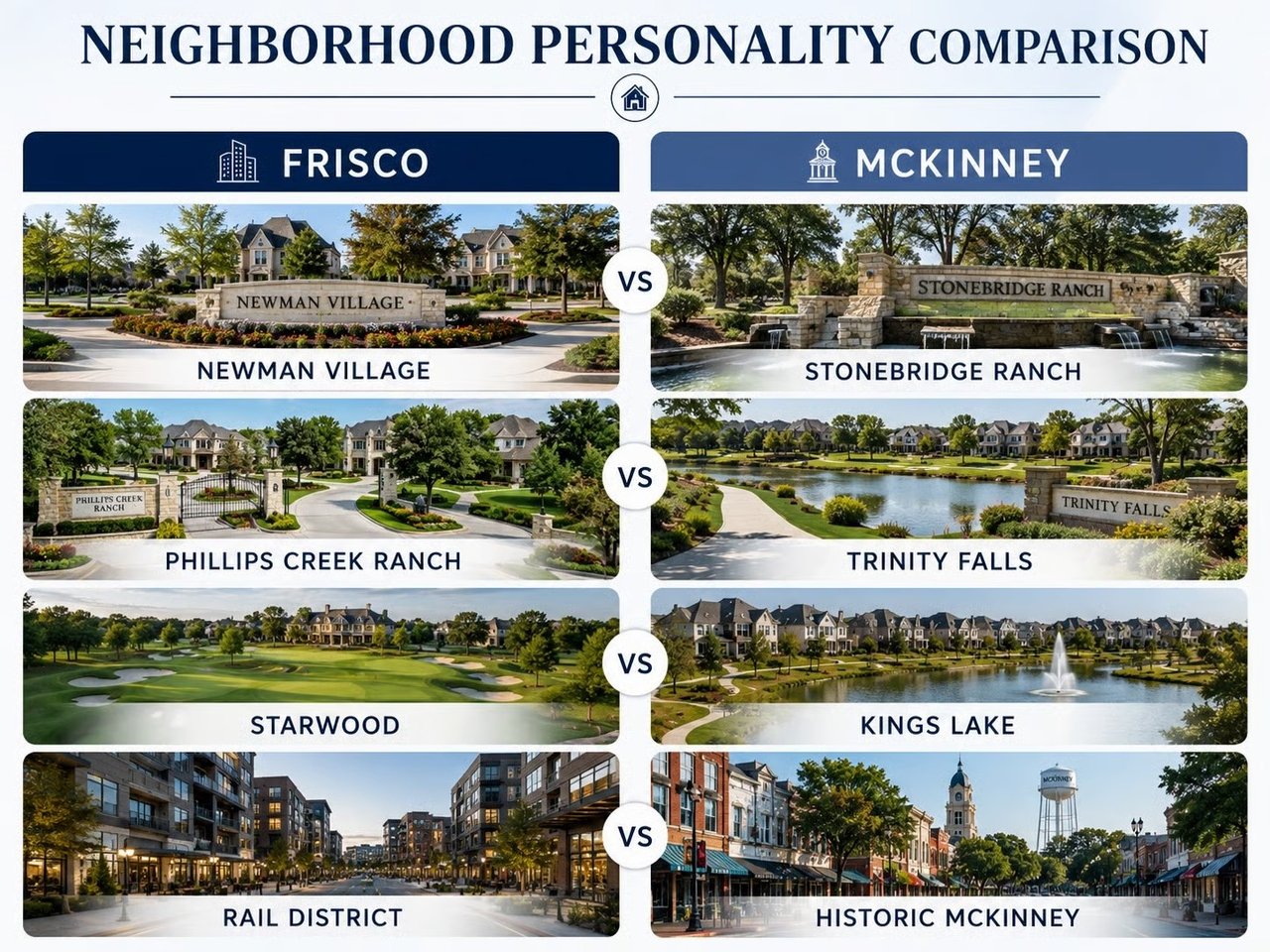
Stonebridge Ranch is a good example. It helped define modern McKinney residential development, but it was added to a city that already had a distinct identity.
Then there are places like Adriatica Village, with its Croatian-inspired architecture, mixed-use design and waterfront setting. Even though Adriatica is newer, it reflects McKinney's tendency to create neighborhoods and districts with a strong individual sense of place.
The city itself uses “Unique by Nature” to describe that identity, specifically pointing to its historic downtown, Adriatica, parks and natural settings.
That isn't just branding. McKinney now has approximately 3,000 acres of parkland and more than 100 miles of trails, and its park system received national CAPRA accreditation in 2025.
Frisco's growth story is different.
The opening of Stonebriar Centre in 2000 helped accelerate the city's transformation. Retail, development, sports, corporate campuses and residential construction followed at enormous scale.
Today, destinations like The Star, PGA Frisco and the Dallas North Tollway corridor are part of Frisco's identity.
McKinney asks, in many ways, “How do we grow without losing what was already here?”
Frisco has had more opportunity to ask, “What should we build next?”
The Shopping and Entertainment Difference
If retail, sports and large-scale entertainment are high on your priority list, Frisco has a clear advantage.
Frisco has deliberately developed itself as a regional destination. Major shopping, restaurants, professional sports facilities and entertainment districts are integrated throughout the city.
McKinney has plenty of shopping and dining, but its strongest destinations tend to feel different.
Historic Downtown McKinney is built around independent shops, restaurants, events and the Square. Adriatica is its own distinct environment. Neighborhood commercial areas are distributed throughout the city.
That means a Saturday can feel different depending on which side of the comparison you prefer.
In Frisco, you might build the day around a major destination.
In McKinney, you may be more likely to spend it walking the Square, eating somewhere local, visiting a park or trail and moving between smaller districts.
Neither is inherently better. They serve different preferences.
If food is part of how you explore a city, my DFW dining guide includes restaurants throughout McKinney, Frisco and the rest of North Texas.
Frisco ISD Made a Very Deliberate Choice About Schools
One of the more interesting differences is something buyers relocating here don't always understand until they start looking at school boundaries.
Frisco ISD deliberately developed a smaller-school model rather than concentrating students into a handful of enormous high schools.
The idea is that a smaller student body can create more opportunities for students to participate — whether that's athletics, fine arts, leadership, clubs or other activities.
You can see that philosophy reflected in the district's own description of Memorial High School: fewer students competing for opportunities can mean a better chance to earn a leadership position, make a team or participate on stage.
That's one reason Frisco has so many high schools.
McKinney ISD has historically operated with fewer, larger comprehensive high schools.
Neither model automatically makes one district “better.” But for families comparing McKinney and Frisco, the structure of the school district can matter almost as much as ratings.
There is another wrinkle: a Frisco mailing address doesn't automatically mean Frisco ISD. Portions of the city are served by Prosper, Lewisville and Little Elm ISDs as well.
Always verify the actual school assignment for a specific home rather than assuming based on the city name.
What About the Homes?
This is where the comparison gets much more nuanced.
Both cities offer everything from relatively attainable production homes to multimillion-dollar properties.
But McKinney generally gives buyers a wider variety of types of environments.
You can find:
- historic homes near downtown
- established tree-lined neighborhoods
- Stonebridge Ranch and other mature master-planned communities
- golf-course communities
- newer production construction
- luxury neighborhoods
- larger lots
- properties closer to open land and natural areas
Frisco's housing stock generally skews newer because so much of the city was developed during its population boom.
You'll find:
- newer master-planned communities
- production and semi-custom construction
- luxury enclaves
- golf-oriented communities
- neighborhoods close to major retail and entertainment
- newer mixed-use and higher-density development
This is also why I don't like answering “Which city is better?” without first asking what you want your everyday life to look like.
McKinney vs. Frisco at a Glance
McKinney | Frisco | |
|---|---|---|
2026 estimated population | ~237,130 | ~248,971 |
City roots | County seat established 1848 | Railroad town developed early 1900s |
Overall feel | Historic + established + growing | Newer + planned + rapidly developed |
Downtown | Large historic courthouse square | Frisco Square + historic Rail District |
Retail | Distributed + downtown/local | Major regional retail destination |
Sports/entertainment | More locally oriented | Major professional sports presence |
Parks/nature | Major part of city identity | Extensive planned recreation |
Housing | Very broad mix of ages/styles | Generally newer housing stock |
School model | Fewer, larger comprehensive high schools | Many smaller high schools |
Best fit | Buyers wanting character + variety | Buyers wanting newer + highly planned |
So, Is McKinney or Frisco Better?
I don't think that's the right question.
The better question is:
Which one feels more like the life you're trying to build?
If you want newer development, major retail, sports, entertainment and highly planned neighborhoods close together, Frisco may feel like the obvious choice.
If you want a historic center, mature neighborhoods, newer communities mixed with older ones, trails and green space, and a little more variation from one part of town to another, McKinney may feel more natural.
And there are plenty of buyers who start convinced they want one and end up choosing the other after spending a day actually driving the neighborhoods.
That's why, when I'm helping someone relocate to North Texas, I don't just send listings.
I want you to see the Square. Drive Stonebridge. See Adriatica. Drive the Tollway through Frisco. Visit The Star. Look at where the grocery store is, how the school route feels and what surrounds the neighborhood after you turn out of the subdivision.
A house can look nearly identical online in McKinney and Frisco.
The life outside the front door won't.
Frequently Asked Questions
Is McKinney older than Frisco?
Yes. McKinney became the Collin County seat in 1848 and incorporated in 1849. Frisco developed around the railroad in the early 1900s and incorporated in 1908.
Which is bigger, McKinney or Frisco?
They're surprisingly close today. McKinney estimates its January 2026 population at approximately 237,130. Frisco's current city estimate is approximately 248,971.
Does McKinney have more historic character than Frisco?
Yes, particularly around Historic Downtown McKinney and the surrounding historic neighborhoods. McKinney developed as the county seat decades before Frisco's founding.
Why does Frisco have so many high schools?
Frisco ISD has intentionally emphasized smaller high-school environments rather than putting very large numbers of students on fewer campuses. The model is intended in part to give more students opportunities to participate in activities, athletics and leadership.
Is every home in Frisco zoned to Frisco ISD?
No. Frisco residents may be served by Frisco ISD, Prosper ISD, Lewisville ISD or Little Elm ISD depending on the property's location. Always verify the specific address.
Which city is better for someone relocating to North Texas?
It depends more on lifestyle than a simple ranking. Frisco generally appeals to buyers prioritizing newer development, major retail, sports and planned communities. McKinney often appeals to buyers who want a combination of historic character, established neighborhoods, newer development and green space.
How do I decide where to look?
Start with lifestyle before listings. Commute, schools, neighborhood age, lot size, proximity to shopping, parks, restaurants and the type of community you want around you can narrow the decision considerably.
I'm Michelle Gifford, a North Texas Realtor who has lived in McKinney for more than 28 years and works throughout McKinney, Frisco and the surrounding communities. If you're trying to figure out which area actually fits rather than simply comparing houses online, that's exactly the kind of conversation I'm happy to have.